
What Is Language Segmentation in AI? 7 Powerful Ways It Improves Modern AI Systems
What Is Language Segmentation in AI?
Artificial intelligence systems are becoming more advanced at understanding how humans actually communicate. But human language is rarely clean, structured, or limited to one language at a time. People often mix English with Spanish, Hindi, Urdu, Arabic, or other languages in the same conversation, especially on social media, messaging apps, and customer support platforms.
That is where language segmentation in AI becomes important.
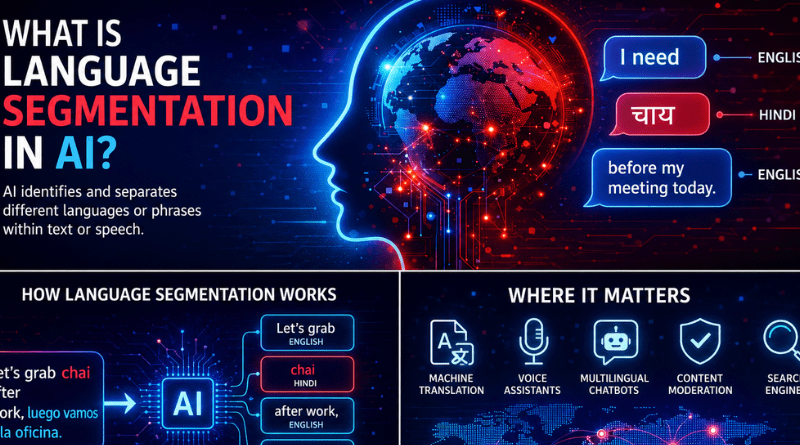
Language segmentation in AI refers to the process of identifying and separating different languages, phrases, or meaningful text units inside speech or written content. Instead of labeling an entire sentence as one language, AI systems break the content into smaller segments and classify each part correctly.
This technology now plays a critical role in machine translation, voice assistants, subtitles, content moderation, multilingual chatbots, and modern Natural Language Processing (NLP) systems.
As AI tools continue expanding globally, language segmentation is becoming one of the foundational technologies behind accurate multilingual communication.
Understanding Language Segmentation in AI
At its core, language segmentation helps AI understand where one language or linguistic unit ends and another begins.
For example, consider this sentence:
“I need chai before my meeting today.”
An advanced AI system may identify:
- “I need” → English
- “chai” → Hindi/Urdu-origin word
- “before my meeting today” → English
This process is especially useful in multilingual regions where people naturally switch languages during conversations. This behavior is commonly known as code-switching.
Traditional language detection systems often fail in these situations because they attempt to classify the entire sentence as a single language.
Language segmentation solves this problem by analyzing smaller text units individually.
Why Language Segmentation Matters in AI
Modern AI systems interact with billions of multilingual users every day. Without language segmentation, many AI tools would misunderstand context, intent, and meaning.
Here are some major reasons why it matters:
1. Improves Machine Translation
Translation systems become more accurate when they recognize mixed-language content properly.
For example, a translation engine should not incorrectly translate brand names, slang, or borrowed words.
2. Enhances Voice Assistants
AI assistants like chatbots and voice systems need to recognize language changes instantly during conversations.
This helps maintain natural responses.
3. Better Social Media Moderation
Users sometimes mix languages to bypass moderation systems. Language segmentation helps platforms detect harmful or misleading content more effectively.
4. Supports Global Business Operations
Companies handling multilingual customer support can analyze conversations more accurately using segmented language models.
5. Improves Search Engine Understanding
Search engines use language recognition to better index multilingual pages and deliver accurate search results.
How Language Segmentation Works
AI systems use multiple methods to identify language boundaries inside text or speech.
Rule-Based Systems
Early systems relied on dictionaries and grammar rules.
For example:
- Detecting script differences
- Identifying known vocabulary
- Using predefined language patterns
While fast, these systems struggled with slang, spelling mistakes, and internet language.
Statistical Models
Later approaches analyzed:
- Character frequency
- Word probability
- Sentence structure
Different languages have unique patterns, helping AI distinguish them more accurately.
Transformer and Deep Learning Models
Modern AI uses transformer-based neural networks similar to those powering large language models.
These systems analyze:
- Context
- Sentence flow
- User intent
- Neighboring words
- Semantic meaning
This allows AI to detect language switches even within very short phrases.
Types of Language Segmentation in AI
Language segmentation is not limited to one format.
Different AI applications use different segmentation levels.
Document-Level Segmentation
The entire document is assigned one primary language.
Used in:
- Web indexing
- Document classification
- Basic translation tools
Sentence-Level Segmentation
Each sentence is analyzed separately.
Used in:
- Chat applications
- Email analysis
- Translation systems
Token-Level Segmentation
Every word or token receives its own language label.
This is common in:
- Social media analysis
- Messaging platforms
- Code-switched conversations
Speech Segmentation
AI breaks continuous audio into meaningful units.
Used in:
- Voice assistants
- Podcasts
- Speech recognition systems
- Real-time transcription
Real-World Examples of Language Segmentation
Language segmentation already powers many technologies people use daily.
Social Media Platforms
Platforms like TikTok, Instagram, and YouTube process multilingual comments and captions constantly.
AI segmentation helps:
- Moderate harmful content
- Recommend content accurately
- Improve translations
Streaming Services
Subtitle and dubbing systems rely heavily on segmentation.
Platforms need AI to:
- Preserve timing
- Maintain emotional tone
- Align translated dialogue with visuals
This is especially important in fast-paced scenes or multilingual productions.
Customer Support AI
Global companies often receive support tickets written in mixed languages.
Segmentation allows AI systems to:
- Detect customer intent
- Route tickets correctly
- Analyze sentiment more accurately
Search Engines
Search engines use segmentation to understand multilingual pages and user queries more effectively.
This improves:
- Search relevance
- Ranking accuracy
- User experience
Language Segmentation vs Tokenization
Many people confuse language segmentation with tokenization, but they are different processes.
| Process | Purpose |
|---|---|
| Language Segmentation | Identifies language boundaries |
| Tokenization | Splits text into words or tokens |
| Sentence Segmentation | Detects sentence endings |
| Topic Segmentation | Divides content by subject |
| Subword Segmentation | Breaks words into smaller AI-friendly units |
Language segmentation focuses specifically on identifying which language belongs to which part of the content.
The Role of Language Segmentation in NLP
Natural Language Processing depends heavily on accurate segmentation.
Without proper segmentation:
- AI translations become inaccurate
- Chatbots misunderstand intent
- Speech recognition quality drops
- Sentiment analysis becomes unreliable
Modern NLP systems combine segmentation with:
- Tokenization
- Named entity recognition
- Intent detection
- Sentiment analysis
- Machine learning models
This creates smarter and more human-like AI interactions.
Common Challenges in Language Segmentation
Despite major progress, language segmentation remains technically difficult.
Shared Alphabets
Languages like English, Spanish, and French share similar scripts, making detection harder.
Slang and Internet Language
Users constantly invent:
- Abbreviations
- Hybrid words
- Informal spellings
AI systems must adapt continuously.
Transliteration
People often write one language using another alphabet.
Example:
- Writing Hindi or Urdu using English letters
This removes script-based clues.
Short Text Problems
Very short messages provide limited context.
Example:
“Bro, kya scene hai?”
AI may struggle without enough surrounding information.
Emojis, Hashtags, and URLs
Modern communication includes:
- Emojis
- Memes
- Links
- Mixed formatting
These elements complicate segmentation models further.
Expert Perspectives on Language Segmentation
Researchers and AI engineers increasingly consider multilingual processing essential for future AI systems.
According to the U.S. Department of Homeland Security’s digital literacy guidance, online communication environments are becoming more linguistically complex, increasing the importance of accurate AI language understanding.
Meanwhile, academic NLP research continues exploring:
- Code-switching datasets
- Cross-lingual transformers
- Speech-language alignment
- Real-time multilingual AI systems
Many experts believe future AI assistants will require near-human multilingual adaptability to function effectively worldwide.
AI Applications That Use Language Segmentation
Several industries already depend on this technology.
Healthcare
Medical transcription systems process multilingual patient interactions.
Education
Language learning apps use segmentation to teach bilingual learners more effectively.
E-commerce
Online stores personalize experiences for multilingual users.
Media and Entertainment
Streaming platforms use segmentation for:
- Subtitles
- Dubbing
- Localization
- Voice synchronization
Cybersecurity and Moderation
AI moderation systems monitor multilingual harmful content online.
Myths About Language Segmentation in AI
Myth 1: AI Understands All Languages Perfectly
Reality: AI still struggles with slang, dialects, and mixed-language communication.
Myth 2: Translation and Segmentation Are the Same
Reality: Translation converts meaning between languages, while segmentation identifies language boundaries first.
Myth 3: Only Big Tech Companies Need It
Reality: Any platform handling multilingual users can benefit from segmentation technology.
The Future of Language Segmentation
As AI becomes more conversational and globally connected, language segmentation will become even more important.
Future developments may include:
- Real-time multilingual voice assistants
- Better cross-cultural AI understanding
- Improved AI accessibility tools
- More accurate multilingual search engines
- Emotion-aware translation systems
Generative AI models like ChatGPT and multilingual large language models already rely on advanced segmentation concepts internally.
The growth of global digital communication means AI must increasingly understand how humans naturally mix languages online.
Actionable Takeaways for Businesses and Developers
Organizations building AI products should:
- Train models on multilingual datasets
- Support code-switched communication
- Improve contextual language detection
- Test AI systems across regional dialects
- Continuously monitor segmentation accuracy
Businesses ignoring multilingual behavior may create poor user experiences in global markets.
FAQs
What is language segmentation in AI?
Language segmentation in AI is the process of identifying and separating different languages or meaningful language units within text or speech.
What is an example of language segmentation?
If someone writes “Let’s grab chai after work,” AI can identify “chai” as a Hindi-origin term while recognizing the rest as English.
Is language segmentation part of NLP?
Yes. Language segmentation is an important component of Natural Language Processing (NLP), especially in multilingual AI systems.
Why is language segmentation important?
It improves translation, voice recognition, chatbots, content moderation, subtitles, and multilingual communication accuracy.
Does ChatGPT use language segmentation?
Large AI language models like ChatGPT rely on advanced multilingual processing systems that include segmentation-related techniques for understanding mixed-language inputs.
Conclusion
Language segmentation in AI may sound highly technical, but it solves a very human problem: the way people naturally communicate across languages, cultures, and digital platforms.
From multilingual chatbots to streaming subtitles and AI moderation systems, segmentation technology quietly powers many tools used every day online.
As artificial intelligence continues expanding globally, understanding mixed-language communication will become even more essential. Companies, developers, and educators investing in multilingual AI systems are likely to benefit from more accurate, inclusive, and human-centered technology experiences.
For more AI and digital literacy explainers, explore related coverage on Fact Nama’s technology section.
Sources: Blockchain Council, Deepdub AI, U.S. Department of Homeland Security, American Psychological Association