
What Is Regenerative AI? 7 Powerful Ways It Could Transform the Future of Artificial Intelligence
What Is Regenerative AI? Understanding the Next Evolution of Artificial Intelligence
By Fact Nama Tech Desk
Artificial intelligence is evolving rapidly, and one of the newest concepts gaining attention in the tech world is what is regenerative AI. While generative AI tools such as OpenAI’s ChatGPT and image generators have already changed how people create content, regenerative AI aims to take the next step by making AI systems capable of improving, correcting, and adapting themselves over time.
Experts describe regenerative AI as a more advanced and responsible approach to artificial intelligence. Instead of simply generating responses or content, these systems continuously learn from outcomes, analyze mistakes, and optimize their future behavior. Supporters believe this could reshape industries ranging from healthcare and finance to cybersecurity and sustainability.
As global discussions around AI ethics, environmental impact, and data reliability continue to grow, regenerative AI is increasingly being viewed as a possible solution to some of the biggest concerns surrounding current AI systems.
What Is Regenerative AI?
To understand what is regenerative AI, it helps to first look at how traditional AI works.
Most current AI systems are trained on massive datasets and then deployed to perform tasks based on that training. Although these systems can produce impressive results, they often rely heavily on fixed models and require frequent human intervention to improve accuracy or fix problems.
Regenerative AI takes a different approach.
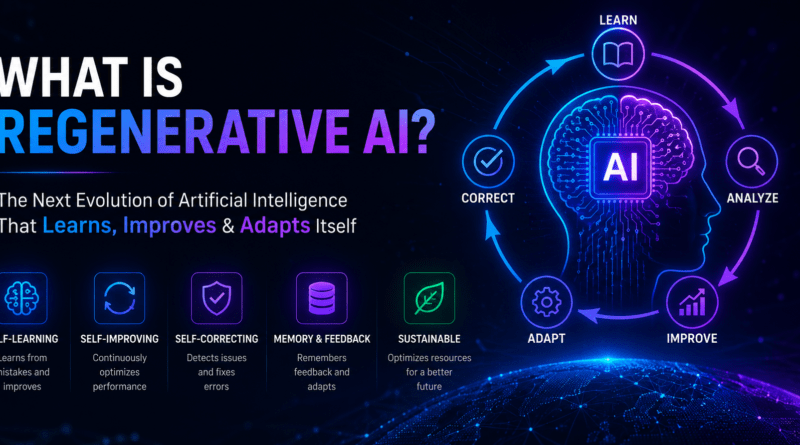
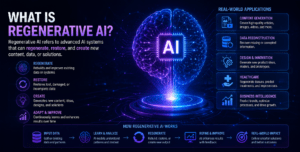
Regenerative AI refers to artificial intelligence systems designed to continuously evaluate, repair, and improve themselves through feedback loops, learning mechanisms, and adaptive processes. In simple terms, these systems aim to become smarter and more reliable over time without requiring constant manual updates.
Technology experts compare regenerative AI to a “self-healing” system. When an issue occurs, the AI can:
- Detect the problem
- Analyze what caused it
- Test possible solutions
- Learn from the outcome
- Adjust future behavior accordingly
This ability to self-correct is what separates regenerative AI from many conventional AI models.
Generative AI vs Regenerative AI
One of the most searched questions online is: What is generative AI vs regenerative AI?
Although the names sound similar, the two technologies serve different purposes.
Generative AI
Generative AI focuses on creating new content such as:
- Text
- Images
- Videos
- Music
- Computer code
Popular examples include ChatGPT, DALL-E, and other AI content-generation tools.
Regenerative AI
Regenerative AI focuses on self-improvement, reliability, and long-term adaptation. Instead of mainly generating content, these systems prioritize:
- Error correction
- Feedback-based learning
- Source verification
- Continuous optimization
- Sustainable AI operations
In short, generative AI creates, while regenerative AI improves and evolves.
How Does Regenerative AI Work?
Another common question people ask is: How does regenerative AI work?
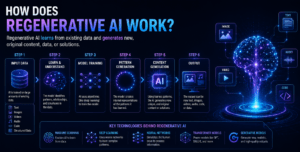
Regenerative AI systems usually operate through several interconnected stages.
1. Grounding in Reliable Data
The AI connects responses to verified information sources, databases, or company documents. This reduces hallucinations and misinformation.
2. Feedback Loops
The system constantly reviews its outputs using human feedback or automated evaluation tools.
3. Memory and Learning
Unlike many standard AI tools, regenerative AI can remember corrections, preferences, and previous interactions to improve future performance.
4. Self-Repair Mechanisms
If errors are identified, the AI attempts to revise and correct its responses before finalizing them.
5. Efficiency Optimization
Some regenerative AI systems are also designed to reduce computing costs and energy consumption by intelligently managing workloads.
These capabilities make regenerative AI especially attractive for industries where accuracy and accountability are critical.
Why Regenerative AI Matters
The growing interest in what is regenerative AI comes at a time when many organizations are struggling with the limitations of current AI systems.
Concerns around AI-generated misinformation, copyright disputes, environmental costs, and unreliable outputs have raised questions about how AI should evolve in the future.
Regenerative AI aims to address several of these concerns by introducing more transparent and responsible systems.
Improved Accuracy
By verifying information and learning from mistakes, regenerative AI could significantly reduce false or misleading outputs.
Greater Trust
Businesses and consumers may trust AI systems more if they can explain decisions and provide evidence for their responses.
Better Sustainability
Some regenerative AI models are designed to optimize energy usage, helping reduce the environmental impact of large AI systems.
Continuous Learning
Instead of remaining static after training, regenerative AI systems continue evolving based on real-world feedback.
Real-World Applications of Regenerative AI
Although still an emerging field, regenerative AI already has several practical applications.
Healthcare
Hospitals could use regenerative AI systems to improve diagnostic accuracy by learning from past patient outcomes and medical reviews.
Finance
Financial institutions may use regenerative AI to detect fraud patterns, improve investment strategies, and reduce risk through continuous adaptation.
Software Development
AI-generated code could automatically test itself, identify bugs, and repair errors before deployment.
Customer Service
Businesses can create AI assistants that continuously improve customer interactions and adapt to user preferences.
Sustainability and Energy
Some experts believe regenerative AI could help optimize energy grids, reduce waste, and support climate-focused initiatives.
Challenges and Risks of Regenerative AI
Despite its potential, regenerative AI still faces significant challenges.
Technical Complexity
Building AI systems capable of safely modifying themselves is extremely difficult and requires advanced monitoring.
Ethical Concerns
There are fears that self-improving AI systems could develop unintended behaviors if not properly controlled.
High Computing Costs
Continuous learning and evaluation require massive computing power, which can be expensive.
Data Privacy Issues
Regenerative AI systems that rely on memory and personalization must carefully handle sensitive user information.
Governance Problems
Experts warn that AI development remains heavily concentrated among major tech companies, raising concerns about monopolies and control.
What Are the 4 Types of AI?
People searching for what is regenerative AI also frequently ask: What are the 4 types of AI?
AI is generally divided into four categories:
- Reactive Machines – Basic AI systems that respond to specific inputs without memory.
- Limited Memory AI – Systems that use past data to improve decisions, such as self-driving cars.
- Theory of Mind AI – Experimental AI capable of understanding emotions and human intentions.
- Self-Aware AI – A hypothetical future form of AI with consciousness and self-awareness.
Regenerative AI is not officially considered a separate category but is viewed as an advanced development built on limited-memory and adaptive AI systems.
Is Regenerative AI the Future?
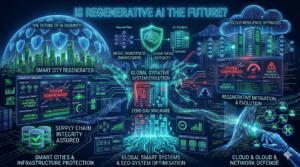
Many analysts believe regenerative AI could become a major focus of the next phase of artificial intelligence development.
Unlike traditional AI models that mainly prioritize speed and scale, regenerative AI emphasizes:
- Responsibility
- Transparency
- Adaptability
- Sustainability
- Human collaboration
Some experts argue that future AI systems will need regenerative capabilities to remain useful and trustworthy in complex real-world environments.
However, others caution that the technology is still in its early stages and may take years before widespread adoption becomes practical.
The Growing Debate Around AI Governance
The rise of regenerative AI has also intensified discussions about AI regulation and governance.
Critics argue that advanced AI systems should not be controlled solely by a small group of powerful corporations. Researchers and policy experts are increasingly calling for:
- Public oversight
- Ethical AI standards
- Transparent data practices
- Environmental accountability
- Fair compensation for creators whose data trains AI models
As governments around the world develop new AI policies, regenerative AI could play an important role in shaping future regulations.
Final Thoughts
The question of what is regenerative AI goes beyond just another technology trend. It represents a broader shift toward creating AI systems that are more reliable, transparent, adaptable, and sustainable.
While generative AI changed how machines create content, regenerative AI aims to change how machines learn, improve, and interact with society over time.
Although the technology remains in its early stages, its focus on self-improvement and accountability could make it one of the most important developments in the future of artificial intelligence.
For businesses, researchers, and policymakers, the challenge now is ensuring that regenerative AI develops in ways that benefit both innovation and humanity.
Read more in our AI & Technology section at Fact Nama