
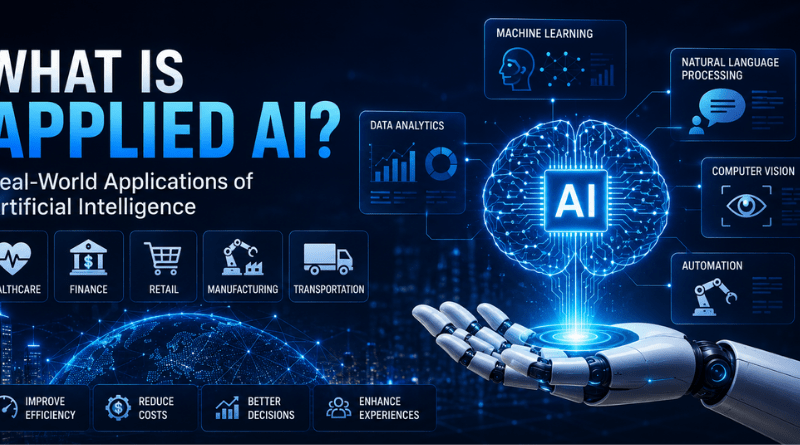
What Is Applied AI? 7 Powerful Real-World Uses Transforming Industries in 2026
What Is Applied AI? Understanding the Real-World Future of Artificial Intelligence.
Artificial intelligence is rapidly changing the modern world, but one term gaining massive attention in 2026 is what is applied AI. Businesses, healthcare organizations, financial institutions, and technology companies are increasingly investing in applied AI solutions to improve productivity, automate workflows, and solve complex real-world problems.
Unlike theoretical AI research, applied AI focuses on practical implementation. It combines technologies such as machine learning, natural language processing (NLP), computer vision, and large language models (LLMs) to create intelligent systems capable of handling industry-specific challenges.
Experts believe what is applied AI has become one of the fastest-growing technology topics because companies now want AI tools that produce measurable business results rather than experimental concepts.
What Is Applied AI?
Simply put, what is applied AI refers to the practical use of artificial intelligence technologies to solve real-world problems. Instead of creating human-like intelligence from scratch, applied AI uses existing AI models and tools to improve efficiency, decision-making, automation, and customer experiences.
Applied AI systems are designed for specific tasks such as:
- Fraud detection
- Medical diagnosis
- Customer service automation
- Personalized recommendations
- Smart manufacturing
- Predictive analytics
Understanding what is applied AI helps businesses identify how artificial intelligence can deliver direct value in everyday operations. Read more in our Technology Section
How Applied AI Differs From General AI
One of the biggest misunderstandings surrounding what is applied AI is confusion between applied AI and general AI.
General AI refers to hypothetical systems that can think and perform tasks like humans across unlimited situations. Applied AI, however, is task-oriented and focused on solving defined problems.
Key Differences Between Applied AI and General AI
| Feature | Applied AI | General AI |
|---|---|---|
| Purpose | Solves specific problems | Mimics full human intelligence |
| Scope | Narrow and industry-focused | Broad and universal |
| Usage | Real-world applications | Mostly theoretical |
| Reliability | Optimized for accuracy | Still under research |
| Examples | Chatbots, fraud detection | Human-level AI systems |
Today, almost every AI system used commercially falls under applied AI.
Key Features of Applied AI
1. Problem-Solving Approach
The biggest strength of applied AI is its focus on solving practical challenges. Companies use AI tools to reduce costs, improve accuracy, and automate repetitive tasks.
For example, banks use AI systems to monitor suspicious financial activity while hospitals use AI imaging tools to detect diseases faster.
2. Multi-Technology Integration
Another important aspect of what is applied AI is the combination of multiple AI technologies into one intelligent system.
Applied AI may include:
- Machine learning algorithms
- Natural language processing
- Computer vision
- Speech recognition
- Predictive analytics
- Generative AI models
These technologies work together to create smarter and more efficient digital solutions.
3. Human and AI Collaboration
Applied AI does not completely replace humans. Instead, it supports professionals by handling repetitive work and providing faster insights.
For instance, AI-powered customer service systems can answer basic questions while human agents focus on more complicated cases.
Real-World Applications of Applied AI
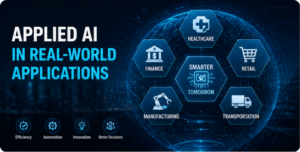
The practical use of what is applied AI is expanding rapidly across industries worldwide.
Applied AI in Healthcare
Healthcare is one of the fastest-growing sectors using applied AI technologies.
Major Healthcare Applications
- AI-powered disease detection
- Personalized treatment recommendations
- Medical image analysis
- Patient monitoring systems
- Virtual healthcare assistants
Hospitals are increasingly using AI tools to improve diagnostic accuracy and reduce treatment delays.
Applied AI in Finance
Financial institutions heavily rely on applied AI for security, automation, and risk analysis.
Financial Industry Uses
- Fraud detection systems
- AI-powered investment analysis
- Smart banking chatbots
- Credit scoring automation
- Financial forecasting
Many companies asking what is applied AI are particularly interested in how AI improves cybersecurity and financial protection.
Applied AI in Retail
Retail businesses use applied AI to improve customer experience and increase sales performance.
Retail AI Examples
- Personalized shopping recommendations
- AI inventory management
- Automated checkout systems
- Customer behavior analysis
- Visual product search
Large e-commerce companies now depend heavily on applied AI systems for targeted marketing and customer engagement.
Applied AI in Transportation
Transportation and logistics industries are also adopting AI technologies at a fast pace.
Common Transportation Uses
- Autonomous vehicles
- Route optimization
- Traffic management systems
- Delivery automation
- Predictive vehicle maintenance
Experts say understanding what is applied AI is becoming essential for future transportation innovation.
What Technologies Power Applied AI?
Applied AI uses several advanced technologies working together.
Machine Learning
Machine learning enables systems to learn from data patterns and improve over time without manual programming.
Natural Language Processing (NLP)
NLP allows machines to understand and respond to human language, powering chatbots and virtual assistants.
Computer Vision
Computer vision helps machines interpret images and videos for tasks such as facial recognition and medical imaging.
Large Language Models (LLMs)
LLMs like OpenAI’s ChatGPT generate human-like text responses and assist in customer communication, education, and research.
What Is the Difference Between Applied AI and Generative AI?
Another common question related to what is applied AI is how it differs from generative AI.
Generative AI mainly focuses on creating content such as:
- Text
- Images
- Videos
- Audio
- Code
Applied AI, however, focuses on solving operational problems. In many cases, generative AI becomes one component within a larger applied AI system.
For example, a customer support platform may use generative AI for responses while machine learning handles ticket classification and fraud monitoring.
Benefits of Applied AI for Businesses
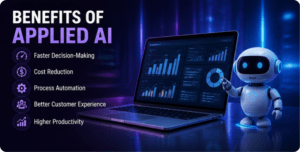
Businesses investing in applied AI are seeing measurable improvements across operations.
Major Advantages Include
- Faster decision-making
- Lower operational costs
- Increased automation
- Improved customer experiences
- Better risk management
- Higher productivity
Understanding what is applied AI helps organizations stay competitive in a rapidly evolving digital economy.
Challenges Facing Applied AI
Despite its advantages, applied AI also presents several challenges.
Key Concerns
- Data privacy risks
- AI bias and fairness issues
- Cybersecurity threats
- High implementation costs
- Lack of skilled professionals
Experts warn that businesses adopting AI must prioritize ethical AI development and transparent data practices.
The Future of Applied AI
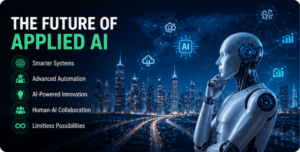
The future of what is applied AI looks extremely promising as industries continue digital transformation efforts.
AI experts predict applied AI will play a major role in:
- Climate change solutions
- Smart cities
- Advanced healthcare systems
- Automated industries
- Education technology
- Personalized digital services
As AI technology becomes more accessible, small businesses and startups are also expected to adopt applied AI tools at a larger scale.
Learning what is applied AI is becoming increasingly important for professionals seeking careers in technology, cybersecurity, finance, and digital innovation.
Final Thoughts
Applied AI is no longer a futuristic concept reserved for research laboratories. It is now a practical technology transforming industries worldwide through automation, intelligent decision-making, and advanced data analysis.
From healthcare and banking to transportation and retail, applied AI solutions are helping businesses solve real-world challenges faster and more efficiently than ever before.
For organizations looking to stay ahead in 2026 and beyond, understanding what is applied AI could become one of the most important steps toward long-term digital success.