
What Is AI Analytics? 7 Powerful Ways AI Is Transforming Data Analysis in 2026
Table of Contents
ToggleWhat Is AI Analytics? Understanding How Artificial Intelligence Is Changing Data Analysis
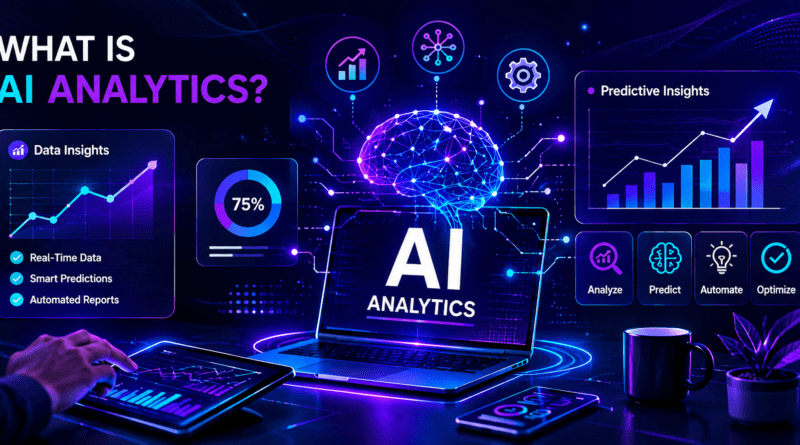
Artificial intelligence is reshaping how businesses collect, process, and understand information. One of the fastest-growing areas in modern technology is AI analytics, a system that combines artificial intelligence with data analysis to generate faster and smarter insights.
As companies generate massive amounts of digital information every day, traditional analytics methods are becoming slower and less efficient. Businesses now rely on AI-powered tools to automate analysis, identify patterns, predict trends, and improve decision-making.
But many users still ask an important question: what is AI analytics and why is it becoming essential in 2026?
In simple terms, AI analytics refers to the use of artificial intelligence technologies such as machine learning, natural language processing (NLP), neural networks, and predictive models to analyze data automatically and generate actionable insights.
From healthcare and e-commerce to marketing and finance, AI analytics is rapidly becoming one of the most valuable tools in the digital economy.
What Is AI Analytics and How Does It Work?
AI analytics works by combining traditional data analysis with intelligent automation.
Instead of manually sorting spreadsheets and reports, AI systems can process enormous amounts of structured and unstructured data within seconds. These systems then identify trends, relationships, risks, and opportunities that humans might overlook. Many businesses are now asking what is AI analytics and how it can improve decision-making using real-time data.
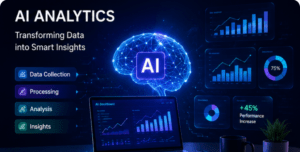
Most AI analytics platforms follow several key steps:
Data Collection
The process starts by gathering information from multiple sources such as:
- Websites
- Customer databases
- Sales reports
- Social media
- Financial systems
- Mobile applications
The more accurate the data, the better the AI analysis becomes.
Data Processing
After collection, AI systems clean and organize the data by removing duplicates, correcting formatting issues, and identifying missing values.
Pattern Recognition
Machine learning algorithms analyze the information to discover patterns and trends.
For example:
- Customer buying behavior
- Website traffic changes
- Product demand
- Fraud detection
- Market forecasting
Predictive Insights
AI systems use historical and real-time data to predict future outcomes.
Businesses can then make faster decisions based on those predictions.
Recommendations and Automation
Modern AI analytics platforms not only analyze information but also suggest actions businesses should take next.
Some systems can even automate tasks without human involvement.
Why AI Analytics Is Becoming Important
The amount of digital data worldwide is increasing rapidly.
Traditional analytics methods often require:
- Manual spreadsheets
- Time-consuming reporting
- Human interpretation
- Delayed decision-making
AI analytics solves many of these problems by providing:
- Real-time analysis
- Faster insights
- Automation
- Improved accuracy
- Better scalability
This is why companies across multiple industries are investing heavily in AI-powered analytics systems.
Types of AI Analytics
Experts generally divide analytics into four major categories.
Descriptive Analytics
Descriptive analytics explains what already happened.
For example:
- Monthly sales performance
- Website traffic reports
- Customer activity summaries
AI improves descriptive analytics by processing larger datasets faster than traditional systems.
Diagnostic Analytics
Diagnostic analytics focuses on why something happened.
AI systems can identify hidden relationships inside complex datasets.
Healthcare organizations, for instance, use AI analytics to detect disease patterns and improve diagnoses.
Predictive Analytics
Predictive analytics forecasts future outcomes based on historical data.
Businesses use predictive AI for:
- Demand forecasting
- Stock market predictions
- Customer behavior analysis
- Sales forecasting
- Risk assessment
This is one of the fastest-growing areas in modern business intelligence.
Prescriptive Analytics
Prescriptive analytics goes one step further by recommending actions.
For example, AI systems may suggest:
- Marketing strategies
- Inventory adjustments
- Delivery schedules
- Pricing changes
This helps organizations improve efficiency and reduce costs.
What Is AI Analytics Used For?
AI analytics is used across many industries to improve decision-making and automate complex tasks.
Business and Marketing
Companies use AI analytics to:
- Understand customer behavior
- Improve advertising campaigns
- Personalize marketing content
- Analyze social media trends
Digital marketers increasingly rely on AI to track campaign performance in real time.
Healthcare
Hospitals and medical researchers use AI analytics for:
- Disease prediction
- Medical imaging analysis
- Patient monitoring
- Treatment recommendations
AI systems can analyze medical records far faster than traditional methods.
Finance and Banking
Banks use AI-powered analytics to detect:
- Fraudulent activity
- Credit risk
- Market trends
- Investment opportunities
Financial institutions depend heavily on predictive analytics for risk management.
E-Commerce
Online stores use AI analytics to optimize:
- Product recommendations
- Inventory management
- Customer targeting
- Pricing strategies
Large e-commerce companies now process millions of customer interactions daily using AI systems.
Cybersecurity
Cybersecurity companies use AI analytics to monitor suspicious behavior, detect threats, and prevent data breaches.
As cyberattacks become more advanced, AI-driven threat detection is becoming increasingly important.
AI Analytics vs Traditional Analytics
There are major differences between traditional analytics and AI-powered analytics systems.
| Traditional Analytics | AI Analytics |
|---|---|
| Relies heavily on manual work | Highly automated |
| Uses historical data mainly | Uses real-time and historical data |
| Slower processing speed | Extremely fast analysis |
| Limited scalability | Handles massive datasets |
| Requires specialized experts | More accessible to businesses |
AI analytics allows organizations to process information faster and make decisions more efficiently.
Technologies Behind AI Analytics
Several advanced technologies power AI analytics systems.
Machine Learning
Machine learning allows systems to learn from data and improve predictions over time.
Natural Language Processing (NLP)
NLP helps AI understand human language, including text, emails, reviews, and social media content.
Neural Networks
Neural networks mimic the structure of the human brain to recognize complex patterns.
Deep Learning
Deep learning uses layered neural networks to process highly complicated datasets.
These technologies work together to improve data interpretation and prediction accuracy. Read more in Fact Nama’s AI & Technology section
Benefits of AI Analytics
Businesses adopting AI analytics often experience major operational improvements. One major reason companies search for what is AI analytics is because AI-powered systems can process huge amounts of information much faster than humans.
Faster Decision-Making
AI systems process information within seconds, allowing businesses to react quickly.
Better Accuracy
AI reduces many human errors involved in manual analysis.
Cost Savings
Automation reduces labor costs and improves efficiency.
Improved Customer Experience
Companies can personalize services based on AI-generated customer insights.
Scalability
AI systems can analyze enormous datasets without requiring large teams.
Risks and Challenges of AI Analytics
Despite its advantages, AI analytics still has limitations.
Data Privacy Concerns
AI systems often process sensitive user information, creating privacy risks.
Bias in AI Models
If training data contains bias, AI systems may generate unfair or inaccurate results.
AI Hallucinations
Some AI tools may generate incorrect or misleading information.
High Setup Costs
Advanced AI systems can be expensive for smaller businesses.
Dependence on Data Quality
Poor-quality data reduces accuracy significantly.
Experts recommend combining AI insights with human oversight to reduce risks.
The Future of AI Analytics
The future of AI analytics is expected to become even more advanced.
Industry experts predict growth in:
- Real-time AI assistants
- Automated business forecasting
- AI-powered dashboards
- Voice-driven analytics
- Predictive healthcare systems
- Smart financial analysis
Generative AI tools are also changing how businesses interact with data by making analytics more conversational and accessible.
As AI technology evolves, organizations that effectively use AI analytics may gain major competitive advantages.
Experts believe what is AI analytics will become one of the most searched technology topics as AI adoption continues to grow globally.
Frequently Asked Questions
What do you mean by AI analytics?
AI analytics refers to using artificial intelligence technologies to process data, identify patterns, and generate business insights automatically.
What are the 4 types of AI analytics?
The four main types are descriptive, diagnostic, predictive, and prescriptive analytics.
Is AI analytics difficult to learn?
Basic AI analytics tools are becoming easier to use, although advanced systems may require technical skills.
Can AI replace data analysts?
AI can automate repetitive analysis tasks, but human analysts still play an important role in strategy, validation, and interpretation.
Is AI analytics useful for small businesses?
Yes. Small businesses use AI analytics for customer insights, marketing optimization, inventory tracking, and forecasting.
Conclusion
AI analytics is transforming how organizations understand and use data in 2026. By combining artificial intelligence with advanced data processing, businesses can generate insights faster, improve forecasting, reduce costs, and make smarter decisions.
From healthcare and finance to e-commerce and cybersecurity, AI-powered analytics is becoming an essential part of modern business operations.
However, experts also warn that AI should complement human decision-making rather than replace it entirely. Businesses that balance automation with responsible oversight are likely to benefit the most as AI technology continues evolving.
For companies competing in data-driven industries, understanding what is AI analytics may become one of the most important digital skills of the future.
Understanding what is AI analytics is becoming essential for businesses, marketers, and technology professionals in the modern digital economy.
Sources: IBM Think, Tableau, Squarespace, industry AI research reports