

15 Powerful Critical Media Literacy Examples That Reveal How Media Shapes Beliefs
Introduction
Media is no longer something we simply consume—it actively shapes how we see the world, understand ourselves, and judge others. From news headlines and political ads to TikTok trends and streaming shows, media messages influence beliefs, values, and behavior every day. This is why understanding critical media literacy examples is essential in today’s digital society.
Unlike basic media literacy, which focuses on identifying credible sources and spotting misinformation, critical media literacy goes deeper. It examines power, representation, ideology, and profit behind media messages. It asks not just “Is this true?” but “Who created this, for what purpose, and who benefits?”
In this guide, Fact Nama breaks down real-world critical media literacy examples across news, advertising, social media, film, and education—showing how these skills work in practice and why they matter for democracy, equity, and informed decision-making.
What Is Critical Media Literacy?
Critical media literacy is the ability to analyze, evaluate, and create media while questioning the social, political, and economic power structures behind it.
It builds on the classic definition of media literacy—access, analyze, evaluate, and create media—by adding a critical lens focused on:
-
Power and ownership
-
Representation and identity
-
Ideology and values
-
Profit motives and influence
Media scholars argue that media is never neutral. Every message reflects choices about what to include, what to exclude, and how reality is framed.
Why Critical Media Literacy Matters More Than Ever
According to the Pew Research Center, a majority of Americans say misinformation and media bias make it harder to be well-informed. Meanwhile, US adults spend over 7 hours per day consuming digital media across platforms.
Critical media literacy helps people:
-
Resist manipulation and propaganda
-
Recognize stereotypes and harmful narratives
-
Understand algorithmic influence
-
Participate meaningfully in civic life
-
Create more ethical and responsible content
Core Questions Behind Critical Media Literacy
Most critical media literacy examples rely on a shared set of questions:
-
Who created this message—and who paid for it?
-
What techniques are used to influence emotion or belief?
-
Who is represented, and who is missing?
-
What values or ideologies are being promoted?
-
Who benefits from this message—and who may be harmed?
These questions turn passive consumption into active analysis.
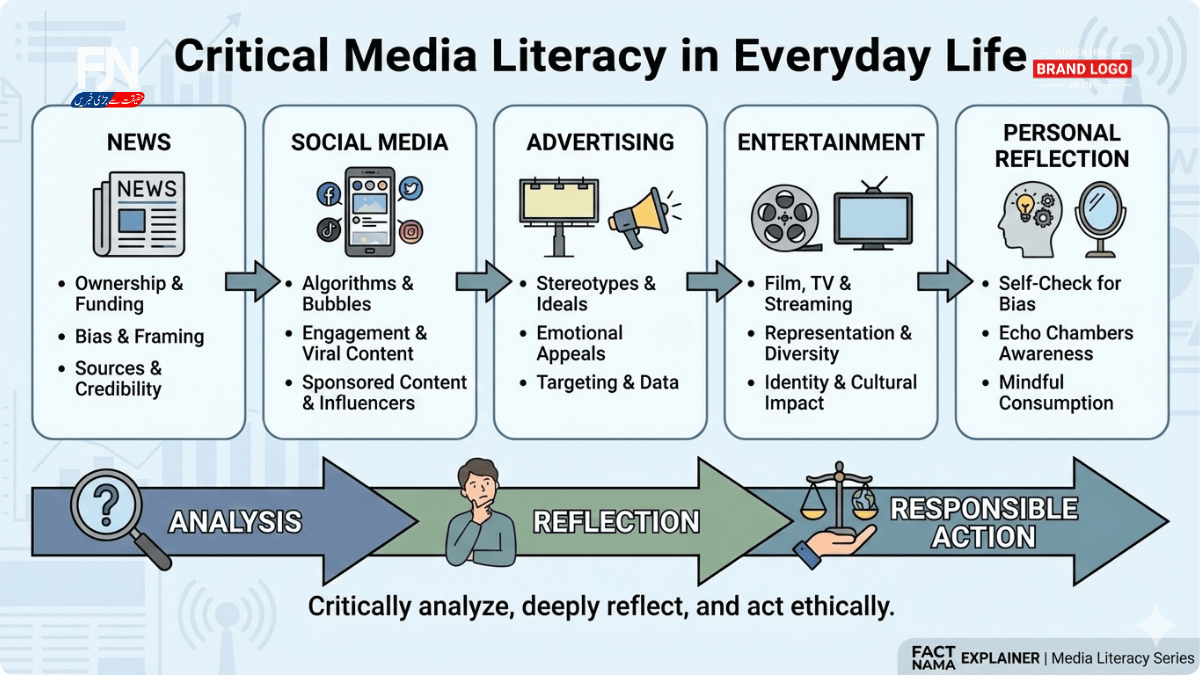
15 Real-World Critical Media Literacy Examples
1. Analyzing News Ownership and Bias
A critical media literacy approach to news goes beyond fact-checking. Readers ask:
-
Who owns this outlet?
-
What political or corporate interests are involved?
-
Which voices are quoted—and which are excluded?
For example, coverage of labor strikes may differ significantly depending on whether a news organization is owned by large corporations or independent trusts.
2. Deconstructing Political Advertisements
Political ads often rely on fear, patriotism, or identity signaling rather than facts.
Critical analysis examines:
-
Emotional triggers
-
Music, imagery, and slogans
-
Simplified “us vs. them” narratives
-
What policies are not explained
This helps viewers separate persuasion from substance.
3. Questioning Social Media Algorithms
Platforms like TikTok, Instagram, and YouTube do not show content randomly.
Critical media literacy examples include:
-
Recognizing echo chambers
-
Understanding why certain posts are repeatedly recommended
-
Identifying sponsored or influencer-driven content
Algorithms prioritize engagement, not accuracy—a key insight for digital citizens.
4. Identifying Stereotypes in Film and TV
Movies and TV shows shape cultural norms.
Critical viewers analyze:
-
Gender roles
-
Racial tropes
-
LGBTQ+ representation
-
Disability portrayals
Tools like the Bechdel Test help reveal systemic patterns rather than isolated issues.
5. Examining Beauty and Lifestyle Advertising
Ads often sell ideals, not just products.
Critical questions include:
-
Who is shown as “successful” or “attractive”?
-
What body types, ages, or ethnicities are missing?
-
Is insecurity being used to drive consumption?
This helps expose how consumer culture profits from self-doubt.
6. Spotting Clickbait and Sensational Headlines
Clickbait headlines exploit emotion to drive traffic.
Critical media literacy looks for:
-
Exaggerated language
-
Missing context
-
Mismatch between headline and article content
This is especially important during breaking news or crises.
7. Evaluating Influencer Marketing
Influencers often blur the line between personal opinion and paid promotion.
Critical analysis asks:
-
Is this sponsored?
-
Who benefits financially?
-
Is transparency provided?
The FTC now requires disclosure—but enforcement varies.
8. Recognizing Propaganda Techniques
Propaganda uses repetition, fear, and simplified messaging.
Examples include:
-
Emotional patriotic appeals
-
Selective use of facts
-
Demonization of groups
Critical literacy helps distinguish persuasion from information.
9. Analyzing Representation in Children’s Media
Children’s shows influence identity formation.
Critical questions include:
-
Who gets to be the hero?
-
Which cultures are normalized?
-
Are differences portrayed respectfully?
This matters for long-term social attitudes.
10. Understanding News Framing During Crises
Media framing affects public response.
For example:
-
Protests framed as “riots” vs “demonstrations”
-
Migrants framed as “threats” vs “families”
Word choice shapes public perception.
11. Examining Data Visualizations and Statistics
Charts can mislead through:
-
Selective data
-
Skewed scales
-
Missing context
Critical media literacy includes questioning how data is presented.
12. Evaluating AI-Generated Content
AI tools now produce news summaries, images, and videos.
Critical users ask:
-
Who trained this system?
-
What biases may exist?
-
Is human oversight involved?
This is an emerging frontier of media literacy.
13. Creating Counter-Narratives
Critical media literacy is not only about critique—it’s about creation.
Examples include:
-
Producing podcasts that amplify marginalized voices
-
Creating videos that challenge stereotypes
-
Writing op-eds that reframe dominant narratives
14. Lateral Reading and Fact-Checking
Instead of staying on one site, critical readers:
-
Open multiple sources
-
Check author credentials
-
Compare coverage
This method is widely supported by academic research.
15. Reflecting on Personal Media Habits
Critical literacy includes self-reflection:
-
Why does this content resonate with me?
-
How does it shape my beliefs?
-
Am I reinforcing an echo chamber?
Common Myths About Critical Media Literacy
Myth 1: It’s about distrusting all media
Reality: It’s about informed trust, not cynicism.
Myth 2: It’s only for students
Reality: Adults need it just as much.
Myth 3: It’s politically biased
Reality: It applies to all media systems and ideologies.
Expert Perspectives
Educators and researchers emphasize that critical media literacy strengthens democracy by creating informed, engaged citizens rather than passive consumers.
According to media education experts, the goal is not to tell people what to think—but to empower them to ask better questions.
How to Practice Critical Media Literacy Daily
-
Pause before sharing content
-
Follow diverse news sources
-
Question emotional reactions
-
Learn basic fact-checking techniques
-
Reflect on whose voices are amplified
FAQs (Rich Snippet Optimized)
What are some examples of critical media literacy?
Examples include analyzing news bias, questioning advertising stereotypes, understanding social media algorithms, and creating media that challenges dominant narratives.
How is critical media literacy different from media literacy?
Media literacy focuses on evaluating accuracy, while critical media literacy examines power, ideology, representation, and profit behind media messages.
Is critical media literacy taught in schools?
It is increasingly included in US education, but implementation varies widely by state and district.
Why is critical media literacy important?
It helps people resist manipulation, understand social inequalities, and participate responsibly in digital society.
Can adults learn critical media literacy?
Absolutely. It is a lifelong skill relevant to news consumption, civic engagement, and online behavior.
Conclusion
Understanding critical media literacy examples is no longer optional—it is a survival skill in an information-saturated world. Media shapes public opinion, cultural norms, and political outcomes, often invisibly.
By learning to question authorship, representation, power, and intent, individuals move from passive consumption to active participation. Critical media literacy does not reject media—it demystifies it.
To deepen your understanding, explore related Fact Nama explainers on media literacy importance, media literacy definition components, and the difference between misinformation, disinformation, and malinformation.
Read More (Fact Nama)
Sources
-
Pew Research Center
-
BBC
-
Reuters
-
Center for Media Literacy
