
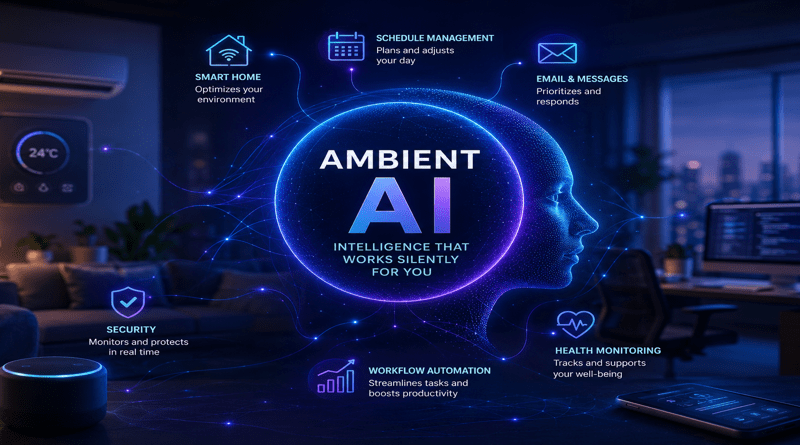
What Is Ambient AI? 7 Powerful Ways Invisible AI Is Transforming Daily Life in 2026
What Is Ambient AI? The Invisible Technology Quietly Changing Everyday Life
Artificial intelligence is no longer limited to chatbots and virtual assistants waiting for commands. A new generation of technology is emerging that works silently in the background, understanding context and taking action automatically. This innovation is known as ambient AI, and it is rapidly becoming one of the most discussed trends in the global tech industry.
The growing interest around what is ambient AI reflects a major shift in how people interact with technology. Instead of manually opening apps, typing prompts, or giving voice commands, ambient AI systems aim to anticipate needs and respond in real time without interrupting workflows.
Technology experts believe this approach could fundamentally reshape workplaces, healthcare systems, smart homes, transportation, and digital communication over the next decade.
The question “what is ambient AI” has become one of the fastest-growing searches in the technology industry during 2026. As businesses invest heavily in automation and smart systems, people want to understand what is ambient AI, how it works, and why experts believe it could become the future of invisible computing. From healthcare to smart homes, ambient AI is changing how users interact with digital environments.
What Is Ambient AI?
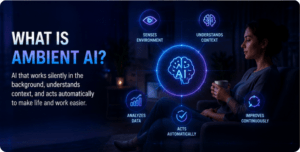
Ambient AI refers to intelligent systems that continuously observe digital or physical environments, analyze contextual information, and act proactively without requiring direct instructions from users.
Unlike traditional AI tools that wait for commands, ambient AI operates in the background. It combines machine learning, sensors, behavioral data, and automation to make decisions based on real-time situations.
In simple terms, ambient AI is designed to make technology feel almost invisible.
For example, instead of asking an AI assistant to summarize a meeting, an ambient AI system may automatically listen, create notes, identify action items, and send follow-up reminders before the meeting even ends.
This seamless approach is why many analysts describe ambient AI as the next evolution of artificial intelligence.
How Is Ambient AI Different From Traditional AI?
One of the biggest differences between traditional AI and ambient AI is interaction style.
Conventional AI systems are reactive. Users must type prompts, click buttons, or give voice instructions to trigger a response. Ambient AI, however, continuously processes information in the background and reacts automatically.
Key Differences Between Ambient AI and Regular AI
| Ambient AI | Traditional AI |
|---|---|
| Always active in the background | Activated only when prompted |
| Context-aware and proactive | Task-focused and reactive |
| Requires minimal user interaction | Depends heavily on user commands |
| Integrated into environments | Usually exists as standalone software |
This shift allows businesses and consumers to reduce repetitive tasks and improve efficiency without constantly engaging with software interfaces.
How Does Ambient AI Work?

Understanding what is ambient AI also requires understanding the technologies behind it.
Ambient AI systems rely on several connected components working together:
- Sensors and IoT devices
- Real-time data streams
- Machine learning algorithms
- Automation systems
- Cloud and edge computing
These technologies collect environmental and behavioral signals such as location, movement, voice patterns, screen activity, schedules, or workflow habits.
The AI system then analyzes those signals to identify patterns, predict intent, and perform actions automatically.
For example, a smart office powered by ambient AI might:
- Adjust lighting based on occupancy
- Schedule meetings automatically
- Prioritize urgent emails
- Generate meeting summaries
- Detect technical issues before equipment fails
All of this can happen with little or no direct human input.
Real-World Examples of Ambient AI
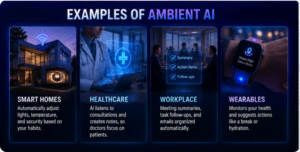
Ambient AI may sound futuristic, but many people are already interacting with it every day.
Smart Homes
Modern smart home systems already use ambient AI features. Devices can learn user habits and automatically adjust room temperature, lighting, or security settings based on behavior patterns.
Smart refrigerators may monitor food supplies and suggest grocery orders, while AI-powered washing machines optimize water usage and detergent levels automatically.
Ambient AI in Healthcare
Healthcare is one of the fastest-growing sectors for ambient AI adoption.
Doctors and nurses often spend large amounts of time on administrative tasks. Ambient AI tools can listen during patient consultations, generate medical notes, organize records, and suggest follow-up actions automatically.
This allows healthcare professionals to focus more on patient care instead of paperwork.
Several medical technology companies are now investing heavily in ambient clinical intelligence systems designed to improve hospital efficiency and reduce burnout among healthcare workers.
Workplace Productivity and Business Automation
Companies are increasingly integrating ambient AI into daily workflows.
Meeting assistants can automatically record discussions, summarize conversations, assign tasks, and update project management systems without manual input.
Customer support platforms can detect frustration in conversations and prioritize urgent tickets instantly.
Sales platforms may analyze conversations and automatically update customer relationship management systems after calls.
For businesses, this means faster operations, reduced administrative work, and better productivity.
Ambient AI vs Agentic AI
Another rising discussion in the AI industry is the difference between ambient AI and agentic AI.
While both technologies aim to automate tasks, they function differently.
Ambient AI
- Operates continuously in the background
- Focuses on context awareness
- Works quietly with minimal visibility
Agentic AI
- Functions like autonomous digital agents
- Performs complex multi-step tasks
- Often requires defined goals or instructions
In many cases, future systems may combine both approaches to create more intelligent digital environments.
Benefits of Ambient AI
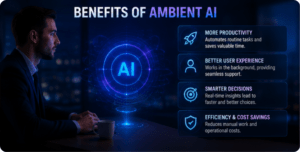
Supporters of ambient AI believe the technology can significantly improve efficiency and user experience.
Reduced Cognitive Load
People spend less time managing repetitive digital tasks.
Faster Decision-Making
Ambient AI can analyze information instantly and respond in real time.
Improved Personalization
Systems adapt based on user behavior and preferences.
Seamless User Experience
Technology becomes less disruptive and more intuitive.
For businesses, these advantages can translate into lower operational costs and higher productivity.
Privacy and Security Concerns
Despite its benefits, ambient AI also raises major privacy and ethical concerns.
Because these systems continuously monitor environments, they often collect large amounts of sensitive data.
Experts warn that improper security measures could expose:
- Personal conversations
- Business documents
- Behavioral data
- Medical information
- Location tracking
Critics argue that always-on AI systems may create surveillance risks if companies fail to establish clear consent policies and data protections.
Cybersecurity specialists also warn about the danger of AI systems making incorrect decisions based on incomplete or manipulated information.
What Responsible Ambient AI Looks Like
Technology experts say responsible ambient AI systems should include:
- Clear user consent options
- Visible recording indicators
- Easy pause and deletion controls
- Strong encryption and security
- Transparent data policies
- Human approval for sensitive actions
As governments worldwide develop AI regulations, companies deploying ambient AI may face stricter compliance requirements in the coming years.
The Future of Ambient AI
Industry analysts believe ambient AI could become one of the defining technologies of the next decade.
As smaller AI models become more powerful, many systems may eventually run directly on smartphones, laptops, and wearable devices instead of relying entirely on cloud servers.
This could improve:
- Privacy
- Processing speed
- Battery efficiency
- Real-time responsiveness
Technology companies are already investing heavily in AI-powered smart glasses, wearable assistants, smart offices, and intelligent home ecosystems.
Experts predict the most successful AI systems of the future may be the ones users barely notice at all.
Why Ambient AI Matters in 2026
The debate around what is ambient AI is becoming increasingly important because the technology represents a shift from visible AI tools to invisible intelligence embedded into daily life.
Instead of interacting directly with machines, users may soon live in environments where technology quietly supports decisions, automates tasks, and anticipates needs in real time.
While challenges around privacy, trust, and governance remain unresolved, ambient AI is already moving from experimental technology into mainstream adoption.
Businesses that successfully integrate ambient AI could gain significant competitive advantages through faster workflows, better customer experiences, and smarter operations.
As the global AI race intensifies, ambient AI may become one of the most influential technologies shaping how people work, communicate, and live in the years ahead.
As discussions around what is ambient AI continue to grow, analysts predict that invisible AI systems will soon become part of everyday life. Businesses adopting ambient AI early may gain a competitive edge through automation, personalization, and improved efficiency. Read more: Fact Nama Technology Section