
Essential Fact Checking Tools: How Journalists Verify Truth in a Misinformation Age 2026
Introduction
False information spreads faster than corrections—and often farther. In an era shaped by social media virality, AI-generated content, and political polarization, fact checking tools have become essential for journalists, researchers, educators, and everyday readers. These tools help verify claims, authenticate images and videos, trace original sources, and separate credible reporting from misleading narratives.
For newsrooms, fact checking is no longer a backroom task; it’s a frontline defense for public trust. For readers, access to reliable verification tools offers a way to pause, question, and confirm before sharing. This guide explains what fact checking tools are, how they work, which platforms professionals rely on, and how anyone can use them responsibly. Whether you’re an aspiring fact checker, a student, or a concerned news consumer, understanding these tools is now a core media literacy skill.
What Are Fact Checking Tools?
Fact checking tools are digital platforms, databases, browser extensions, and verification techniques designed to confirm the accuracy of claims, images, videos, and sources. They help users answer a simple but critical question: Is this information true, misleading, or false?
Unlike opinion analysis or editorial judgment, fact checking relies on evidence—official records, primary documents, data sets, expert consensus, and verifiable media metadata. Modern tools often combine search technology, reverse-image analysis, and open-source intelligence (OSINT) methods to track how a claim originated and whether it holds up under scrutiny.
Why Fact Checking Tools Matter More Than Ever
The scale and speed of digital misinformation have outpaced traditional editorial safeguards. According to research cited by Pew Research Center, a majority of adults encounter made-up or misleading news online with regularity. Algorithm-driven feeds reward engagement, not accuracy, allowing unverified claims to gain traction before corrections appear.
Fact checking tools address this gap by:
-
Reducing harm caused by viral falsehoods
-
Protecting newsroom credibility and editorial standards
-
Supporting informed civic participation
-
Improving media literacy for non-journalists
In short, these tools help restore context and evidence in an information ecosystem that often strips both away.
Core Categories of Fact Checking Tools
1. Claim Verification Platforms
These databases allow users to search whether a claim has already been checked by professional fact-checkers.
Key examples include:
-
Google Fact Check Explorer – Aggregates verified claims from global fact-checking organizations using ClaimReview markup.
-
Snopes – One of the oldest platforms debunking viral rumors, hoaxes, and social media claims.
-
PolitiFact – Rates political statements using a standardized Truth-O-Meter system.
These tools save time by preventing duplication and offering transparent evidence trails.
2. Image Verification Tools
Visual misinformation—misattributed photos, edited images, or AI-generated visuals—often feels more convincing than text.
Common image fact checking tools include:
-
Reverse image search engines (Google Images, TinEye)
-
Metadata viewers to inspect EXIF data
-
AI-detection tools for synthetic images
Image verification is especially important during breaking news, natural disasters, and conflict reporting, where old images are frequently reused out of context.
3. Video Verification Tools
Video misinformation spreads rapidly on platforms like TikTok, X, and YouTube. Verification often requires breaking videos into frames and tracing their earliest appearance.
Professional newsrooms frequently rely on:
-
Frame extraction tools
-
Platform timestamp analysis
-
Contextual cross-referencing with trusted outlets
Organizations like Reuters routinely publish explainers on how their teams verify user-generated video before publication.
4. Source & Website Credibility Tools
Not all misinformation is viral; much of it hides behind professional-looking websites and pseudo-experts.
Fact checking tools for source evaluation include:
-
Domain registration lookups
-
Archive tools to view historical site changes
-
Author background verification through academic or professional databases
These methods help identify coordinated disinformation networks and content farms.
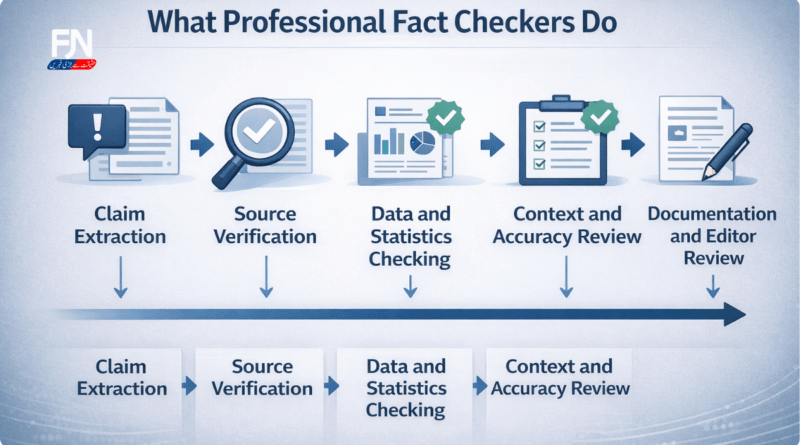
How Journalists Use Fact Checking Tools Step by Step
-
Isolate the claim – Identify the exact statement, image, or statistic.
-
Trace the origin – Find where it first appeared and who shared it.
-
Cross-check evidence – Compare with primary sources and reputable outlets.
-
Verify context – Ensure timing, location, and framing are accurate.
-
Document findings – Maintain transparency with links and citations.
This structured approach separates professional fact checking from casual online skepticism.
Myths vs. Facts About Fact Checking Tools
Myth: Fact checking tools are only for journalists.
Fact: Many tools are free and accessible to students, educators, and the public.
Myth: AI fact checkers are fully reliable.
Fact: AI assists verification but still requires human judgment and context.
Myth: If a claim appears on social media, it must be new.
Fact: Many viral claims resurface years later with altered framing.
Expert Perspective: Verification as a Journalistic Skill
Editors increasingly view verification as a core reporting competency, not a specialized task. Training programs supported by organizations like BBC emphasize open-source investigation skills alongside traditional reporting.
The takeaway is clear: tools don’t replace editorial judgment—they strengthen it.
Actionable Tips for Everyday Readers
You don’t need a newsroom badge to verify information. Start with these habits:
-
Pause before sharing emotionally charged content
-
Use at least one independent verification source
-
Check publication dates and original contexts
-
Follow professional fact-checking organizations
Small actions can significantly reduce misinformation spread.
Frequently Asked Questions (FAQ)
Is fact checking part of copy editing?
No. Copy editing focuses on clarity and grammar, while fact checking verifies accuracy and evidence.
What is another word for fact-check?
Verification, corroboration, or claim validation are commonly used alternatives.
Can AI tools replace human fact checkers?
No. AI assists with speed and pattern recognition but lacks contextual judgment and ethical reasoning.
Are free fact checking tools reliable?
Many free tools are highly reliable when used correctly and cross-referenced.
Conclusion
Fact checking tools are no longer optional accessories to journalism—they are foundational to trust, accountability, and informed public discourse. From claim databases to image and video verification platforms, these tools empower both professionals and citizens to challenge falsehoods with evidence.
As misinformation tactics evolve, so must verification skills. Learning how to use fact checking tools responsibly is one of the most practical forms of media literacy today.
For deeper insights, explore Fact Nama’s guides on how to become a professional fact checker and media literacy and critical thinking to strengthen your verification skills further.
Read More (Fact Nama)
Sources
-
Reuters Verification Handbook
-
BBC Editorial Guidelines
Fact Nama — Independent journalism, verified.

Pingback: Media Literacy Definition & Key Components: 9 Essential Skills Everyone Needs in the Digital Age » Fact Nama