
25 Proven Critical Media Literacy Lesson Plans for Classrooms and Digital Citizens
Introduction
In a world shaped by social media algorithms, 24-hour news cycles, influencer culture, and AI-generated content, teaching students how to consume media is no longer enough. They must learn how to question it. This is where critical media literacy lesson plans play a vital role.
Critical media literacy moves beyond identifying fake news or checking sources. It encourages students to examine power, representation, bias, ideology, and profit motives behind media messages. From TikTok videos and TV shows to political ads and viral memes, media influences how young people see themselves and society.
This Fact Nama guide offers a comprehensive, classroom-ready overview of critical media literacy lesson plans—including definitions, grade-level examples, teaching frameworks, common myths, expert insights, and actionable strategies educators can apply immediately across elementary, middle, high school, and higher education settings.
What Are Critical Media Literacy Lesson Plans?
Critical media literacy lesson plans are structured teaching guides that help students actively analyze and evaluate media by asking deeper questions about:
-
Who created the message and why
-
Who benefits from it—and who may be harmed
-
How identities, cultures, and power are represented
-
What values or ideologies are embedded
Unlike traditional media literacy lessons that focus on credibility and accuracy alone, critical media literacy emphasizes social awareness, democratic participation, and ethical responsibility.
Why Critical Media Literacy Matters in Today’s Classrooms
According to the Pew Research Center, a majority of US adults believe misinformation is a major problem, and younger audiences encounter news primarily through social platforms. At the same time, students are exposed to:
-
Algorithm-driven content feeds
-
Influencer marketing disguised as opinion
-
AI-generated images and videos
-
Politically polarized narratives
Critical media literacy lesson plans help students:
-
Recognize manipulation and bias
-
Understand how media shapes identity and belief
-
Develop independent thinking skills
-
Become responsible digital citizens
Educators increasingly view these lessons as essential civic education, not optional enrichment.
Core Principles Behind Effective Critical Media Literacy Lessons
Most high-quality critical media literacy lesson plans are built on five foundational principles:
1. Media Messages Are Constructed
Every media text reflects choices—what to include, what to exclude, and how to frame reality.
2. Media Is Not Neutral
All media carries values, assumptions, and ideological perspectives.
3. Media Shapes Power and Identity
Media influences how groups are represented and how audiences see themselves.
4. Audiences Interpret Media Differently
Meaning is not fixed; it depends on background, culture, and experience.
5. Media Has Social and Economic Impact
Profit motives, ownership, and political interests affect content.
Grade-Level Critical Media Literacy Lesson Plan Examples
Elementary School (Grades K–5)
At this level, lesson plans focus on awareness and basic questioning, not abstract theory.
Common lesson themes include:
-
Ads vs entertainment
-
Good vs evil narratives
-
Animation vs reality
-
Fairness and stereotypes
Example Activity:
Students compare two toy commercials and discuss:
-
Who the ad is for
-
How music and colors influence feelings
-
What is realistic vs exaggerated
Learning Outcome:
Students learn that media is designed to persuade, not just inform.
Middle School (Grades 6–8)
Middle school lesson plans introduce representation, bias, and emotional manipulation.
Common lesson themes include:
-
Social media influence
-
Celebrity culture
-
Gender and racial stereotypes
-
Violence and humor
Example Activity:
Students analyze a popular TV show or YouTube channel and track:
-
Who gets the most screen time
-
How teens are portrayed
-
Which behaviors are rewarded
Learning Outcome:
Students begin connecting media messages to real-world attitudes and norms.
High School (Grades 9–12)
High school critical media literacy lesson plans emphasize power, ideology, and civic impact.
Common lesson themes include:
-
News bias and framing
-
Political advertising
-
Algorithms and echo chambers
-
Misinformation and disinformation
Example Activity:
Students compare coverage of the same news story from three outlets and evaluate:
-
Headline framing
-
Source selection
-
Language differences
Learning Outcome:
Students develop advanced analytical and media comparison skills.
College and Adult Education
At higher levels, lessons focus on systemic analysis and media production.
Common lesson themes include:
-
Media ownership and consolidation
-
Digital surveillance and privacy
-
AI-generated media ethics
-
Counter-narratives and activism
Example Activity:
Students create a media project that challenges a dominant narrative and explain their editorial choices.
Learning Outcome:
Learners move from critique to ethical media creation.
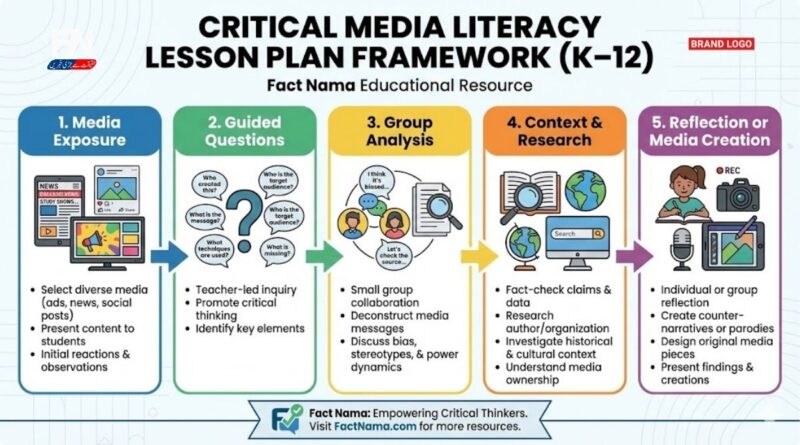
Sample Critical Media Literacy Lesson Plan Framework
A reusable structure educators can adapt:
Step 1: Media Exposure
Show a video, article, meme, ad, or social post.
Step 2: Guided Questions
Ask:
-
Who created this?
-
What techniques are used?
-
What messages are explicit or hidden?
Step 3: Group Analysis
Students discuss interpretations and perspectives.
Step 4: Context and Research
Introduce background information or alternative viewpoints.
Step 5: Reflection or Creation
Students write, debate, or create media responding critically.
Integrating Digital and Social Media Literacy
Modern critical media literacy lesson plans increasingly address:
-
TikTok and Instagram trends
-
Influencer marketing disclosure
-
Algorithmic recommendation systems
-
Viral misinformation
Key teaching focus:
Understanding that platforms prioritize engagement, not truth.
This connects directly to lessons on fact-checking for students and misinformation vs disinformation, topics already explored on Fact Nama.
Common Myths About Critical Media Literacy Lesson Plans
Myth 1: They Promote Political Bias
Reality: Critical media literacy teaches how to think, not what to think.
Myth 2: They Are Too Complex for Younger Students
Reality: Concepts can be adapted age-appropriately using stories and visuals.
Myth 3: Media Literacy Is Only About Fake News
Reality: It also addresses culture, identity, advertising, and power.
Myth 4: Only English Teachers Should Teach It
Reality: These lessons apply to social studies, science, health, and technology classes.
Expert Perspectives on Media Literacy Education
Media education researchers emphasize that critical media literacy strengthens democracy by creating informed, reflective citizens rather than passive consumers.
Educators from organizations like NCTE, PBS, and Media Smarts argue that ignoring media influence leaves students vulnerable to manipulation, stereotyping, and disengagement.
As one media scholar notes, the goal is not media rejection—but media understanding.
Actionable Tips for Educators and Parents
-
Use real, current media examples students recognize
-
Encourage respectful discussion and multiple viewpoints
-
Avoid lecturing—ask questions instead
-
Connect lessons to students’ digital lives
-
Model critical media habits yourself
FAQs – Critical Media Literacy Lesson Plans
What are critical media literacy lesson plans?
They are structured teaching guides that help students analyze media messages by examining power, representation, bias, and intent.
Are critical media literacy lesson plans suitable for all grades?
Yes. They can be adapted from kindergarten through college with age-appropriate content.
How are these different from media literacy lessons?
Media literacy focuses on credibility; critical media literacy examines ideology, influence, and social impact.
Do these lesson plans align with US education standards?
Many align with Common Core, civic education, and digital citizenship frameworks.
Can parents use critical media literacy lesson plans at home?
Absolutely. Discussions around ads, news, and social media are effective learning opportunities.
Conclusion
Critical media literacy lesson plans are no longer optional additions to education—they are foundational skills for navigating modern life. From classroom discussions to everyday media consumption, these lessons empower learners to question narratives, recognize bias, and participate responsibly in digital society.
By teaching students how media works—not just what it says—educators help build a generation capable of informed judgment and ethical communication.
To deepen your understanding, explore related Fact Nama explainers on media literacy importance, media literacy definition components, critical media literacy examples, and fact-checking for students.
Read More (Fact Nama)
Sources
- Read Write Think Org
-
PBS LearningMedia
- Youth Relation Ships Org
