
Artificial Intelligence Explained: 15 Real Uses, Risks, Policies & Future Impact
Introduction
Artificial Intelligence Explained often sounds technical, but the idea behind it is simple. Artificial Intelligence refers to computer systems designed to perform tasks that normally require human intelligence. In reality, the idea is simple. AI refers to computer systems designed to perform tasks that normally require human intelligence. That includes recognizing speech, understanding images, finding patterns in data, or making decisions based on past experience. AI is now part of everyday life. It helps your phone unlock using your face, suggests what to watch next, filters spam emails, and routes traffic on maps. Businesses use it to predict demand. Hospitals use it to assist doctors. Governments use it to analyze data and deliver services more efficiently.
What makes AI different from older software is its ability to learn from data. Instead of following fixed rules written line by line, many AI systems improve as they process more information. This is why AI tools feel more “adaptive” than traditional programs.
Understanding Artificial Intelligence matters even if you are not a developer, researcher, or policymaker. AI affects jobs, privacy, education, media, and public trust. Decisions made by AI systems can influence credit approvals, hiring, medical care, and what information people see online.
This pillar guide explains Artificial Intelligence in clear, plain English. It covers how AI works, where it is used, its benefits, real risks, global rules, ethical concerns, and what the future may realistically look like. The goal is not to impress, but to inform. This guide is written for readers who want clarity, not hype.
What is Artificial Intelligence? (Explained Simply)
Simple definition of AI
Artificial Intelligence is the ability of a machine or software system to perform tasks that usually require human intelligence. These tasks include learning from experience, recognizing patterns, understanding language, and making decisions.
AI does not mean consciousness or emotions. Most AI systems today are tools designed to solve specific problems. They work by analyzing large amounts of data and finding useful patterns within it.
The term “Artificial Intelligence” was first introduced by John McCarthy, who is widely known as the father of AI. His original idea was to see whether machines could be made to simulate aspects of human thinking. Today’s AI is more practical and task-focused than that early vision.
How AI works (data, algorithms, learning)
AI systems rely on three core elements: data, algorithms, and learning.
Data is the fuel. AI models are trained on large datasets such as images, text, audio, or numbers. The quality of the data strongly affects how well the AI performs.
Algorithms are the instructions that tell the system how to analyze data. In machine learning, these algorithms adjust themselves as they process more examples.
Learning happens when the system improves its performance over time. For example, an AI trained to recognize faces becomes more accurate after analyzing millions of labeled images.
Difference between AI, automation, and traditional software
Traditional software follows fixed rules written by programmers. If the input is the same, the output is always the same.
Automation uses software to repeat tasks without human input, but it still relies on predefined rules.
AI is different because it can adapt. Instead of being told every step, it learns patterns from data and applies them to new situations. That flexibility is what makes AI powerful, but also harder to control.
Types of Artificial Intelligence
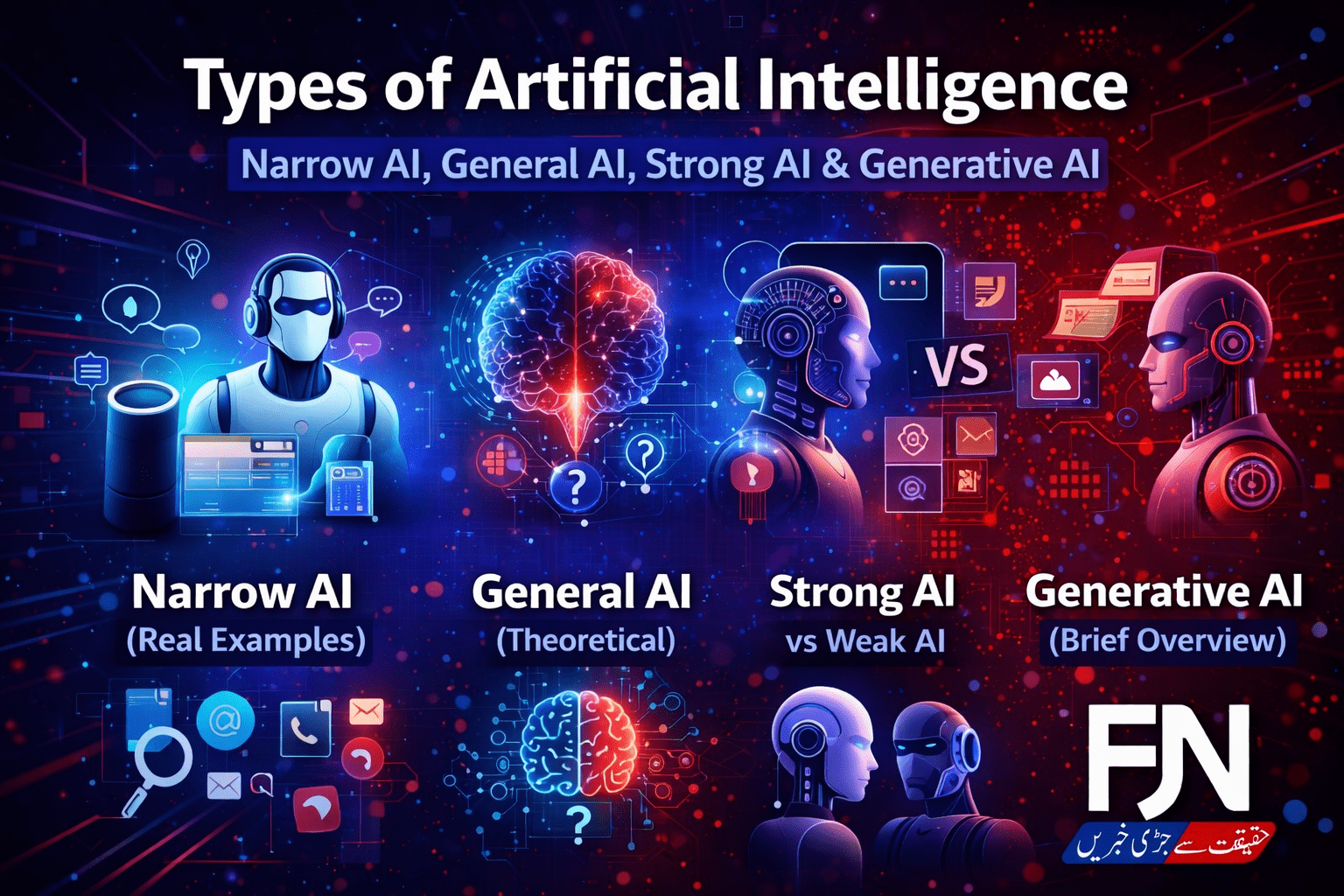
Narrow AI (with real examples)
Narrow AI, also called weak AI, is designed to perform one specific task well. Almost all AI systems in use today fall into this category.
Examples include voice assistants, recommendation engines, facial recognition systems, spam filters, and navigation apps. These systems do not understand the world broadly. They excel only within the narrow area they were trained for.
A medical imaging AI can detect tumors in scans but cannot hold a conversation. A language model can write text but cannot diagnose diseases on its own.
General AI (theoretical, not available today)
General AI refers to a hypothetical system that can understand, learn, and apply intelligence across a wide range of tasks, similar to a human.
This type of AI does not exist today. Researchers debate whether it is achievable or even desirable. General AI would require reasoning, common sense, emotional understanding, and adaptability far beyond current systems. For a deeper understanding of content-creating systems, read our detailed guide on what generative AI is and how it is used today.
Strong AI vs Weak AI
Weak AI is task-focused and lacks awareness. Strong AI is a philosophical concept describing a machine with consciousness or self-awareness.
All existing AI is weak AI. Strong AI remains a topic of academic discussion and science fiction rather than real-world deployment.
Generative AI (brief overview only)
Generative AI refers to systems that can create new content such as text, images, audio, or video based on training data.
These models do not “understand” creativity. They generate outputs by predicting patterns. For deeper coverage, see Fact Nama’s supporting guides on what generative AI is and how applied AI systems are used in real industries. Because these systems rely on patterns in data, they can also reproduce errors or biases present in their training material.
This article, Artificial Intelligence Explained, focuses on helping everyday readers understand how AI works, where it is used, and why it matters beyond technical circles.
How Artificial Intelligence Is Used Today
AI in daily life (phones, apps, search engines)
AI quietly powers many tools people use every day. Smartphones use AI for camera enhancements, voice typing, and battery optimization. Search engines use AI to understand queries and rank results. Streaming platforms suggest content based on viewing history.
Email providers rely on AI to detect spam and phishing attempts. Translation apps use AI to convert languages in near real time. Navigation apps predict traffic and suggest faster routes.
These uses often go unnoticed, but they shape daily digital experiences.
AI in business and industry
Companies use AI to analyze customer behavior, manage inventory, detect fraud, and automate support services. In manufacturing, AI monitors equipment to predict failures before they happen.
Retailers use AI to forecast demand and personalize marketing. Financial institutions apply AI models to assess risk and monitor transactions for suspicious activity.
The goal is usually efficiency, accuracy, and scale rather than replacing humans entirely.
AI in healthcare, education, and finance
In healthcare, AI assists doctors by analyzing scans, identifying patterns in patient data, and supporting early diagnosis. It does not replace medical professionals but helps them make more informed decisions.
In education, AI supports personalized learning, automated grading, and accessibility tools such as speech-to-text services. Institutions also develop academic integrity AI policies to manage responsible use.
In finance, AI helps with credit scoring, fraud detection, and market analysis. These systems must be carefully monitored to avoid unfair outcomes.
AI in media and content creation
AI tools are increasingly used in media for transcription, translation, photo tagging, and content moderation. Some newsrooms use AI to assist with data analysis or draft routine reports, while editors retain final control.
The rise of AI-generated content has also raised concerns about authenticity, accuracy, and misinformation, making human oversight essential.
Benefits of Artificial Intelligence
Artificial Intelligence offers clear advantages when used responsibly.
Speed and efficiency are major benefits. AI systems can process vast amounts of data far faster than humans, helping organizations respond quickly to changing conditions.
AI also supports better decision-making by identifying patterns that may not be obvious. In healthcare, this can mean earlier detection of disease. In business, it can mean smarter planning.
Cost reduction is another advantage. Automation powered by AI can reduce repetitive workload, allowing people to focus on higher-value tasks.
AI improves accessibility as well. Voice assistants help users with disabilities interact with technology. Translation tools break language barriers. When designed carefully, AI can expand access rather than limit it.
Risks and Challenges of Artificial Intelligence
Data privacy concerns
AI systems often rely on personal data. If data is collected, stored, or shared improperly, privacy can be compromised. Strong safeguards and transparency are essential.
Bias and fairness issues
AI can reflect biases present in training data. This may lead to unfair outcomes in hiring, lending, or law enforcement. Bias testing and diverse data sources are critical.
Job displacement fears
AI can automate certain tasks, raising concerns about job loss. In reality, many roles evolve rather than disappear, but transitions can be difficult without retraining support.
Misinformation and deepfakes
AI can generate realistic but false images, audio, and video. This threatens public trust and makes verification more important than ever.
Over-dependence on AI
Relying too heavily on AI can weaken human judgment. AI should assist decision-making, not replace responsibility.
AI Policies, Rules, and Governance
Why AI regulation is needed
AI systems affect rights, safety, and trust. Regulation helps set boundaries, ensure accountability, and protect users from harm.
Government and global policy approaches
Different countries take different approaches. Some focus on innovation, others on strict oversight. International cooperation is still evolving.
AI in education and academic integrity
Schools and universities are developing academic integrity AI policies to clarify acceptable use, prevent misuse, and support learning rather than shortcuts.
Platform-level AI policies
Technology platforms publish acceptable use policies to govern how AI tools can be applied. These rules aim to reduce misuse while allowing innovation.
According to reporting by the BBC, governments and experts are still debating how to regulate AI systems without slowing innovation.
Ethical Use of Artificial Intelligence
Ethical AI focuses on transparency, accountability, and human oversight. Users should know when AI is involved in decisions that affect them.
Developers and organizations must remain responsible for outcomes. AI systems should be tested, monitored, and corrected when problems arise.
Responsible AI development is not just a technical issue. It is a social one that requires input from educators, policymakers, and the public.
The Future of Artificial Intelligence Explained
Short-term future (next 5 years)
AI will continue to integrate into existing tools. Improvements will focus on reliability, safety, and efficiency rather than dramatic leaps.
Long-term possibilities
Long-term developments may include more adaptive systems and better collaboration between humans and machines. Full human-level intelligence remains uncertain.
What AI may not be able to replace
Creativity, empathy, moral judgment, and complex social understanding remain human strengths.
Human and AI collaboration
The most realistic future is one where AI supports people rather than replaces them. Success depends on thoughtful design and clear boundaries.
Common Myths About Artificial Intelligence
One common myth is that AI will replace all jobs. In reality, it changes how work is done rather than eliminating work entirely.
Another myth is that AI thinks like humans. AI processes data; it does not understand meaning or intent.
There is also a belief that AI is always accurate. AI systems can make mistakes, especially when data is flawed or contexts change.
Understanding these limits helps users approach AI with realism rather than fear.
How to Prepare for an AI-Driven World
Learning how AI works at a basic level helps people adapt. Critical thinking, digital literacy, and ethical awareness are increasingly important.
For professionals, focusing on skills that complement AI, such as problem-solving and communication, is more valuable than competing with automation.
For society, the challenge is to guide AI development in ways that benefit people broadly, not just a few industries.
Final Thoughts
Artificial Intelligence Explained is not about predicting the future, but about understanding how AI already shapes daily life, work, and decision-making.
Artificial Intelligence is neither magic nor menace. It is a powerful set of tools shaped by human choices. Understanding AI, its uses, and its limits is essential for navigating modern life with confidence and clarity.
