
Fake News Detection Explained: How AI, Journalism, and Media Literacy Fight False Information 2026
Table of Contents
ToggleIntroduction
False headlines can travel across the internet in minutes, shaping opinions long before corrections catch up. From manipulated videos to misleading political claims, fake news has become one of the most serious challenges facing modern information ecosystems. This is where fake news detection plays a critical role.
Fake news detection refers to the methods—both human and automated—used to identify intentionally false or misleading content presented as legitimate news. Once a niche academic concern, it is now central to journalism, social media governance, public policy, and everyday media consumption. Newsrooms rely on it to protect credibility, platforms use it to limit harm, and readers depend on it to make informed decisions.
This in-depth guide explains how fake news detection works, why it matters, the role of artificial intelligence, and what individuals can do to spot false information before it spreads.
What Is Fake News Detection?
Fake news detection is the process of identifying news content that is deliberately false, misleading, or manipulated to deceive audiences. Unlike honest reporting errors, fake news is created with intent—often to influence political views, generate clicks, provoke outrage, or undermine trust.
Detection involves analyzing:
-
Content (language, visuals, tone)
-
Context (timing, framing, source credibility)
-
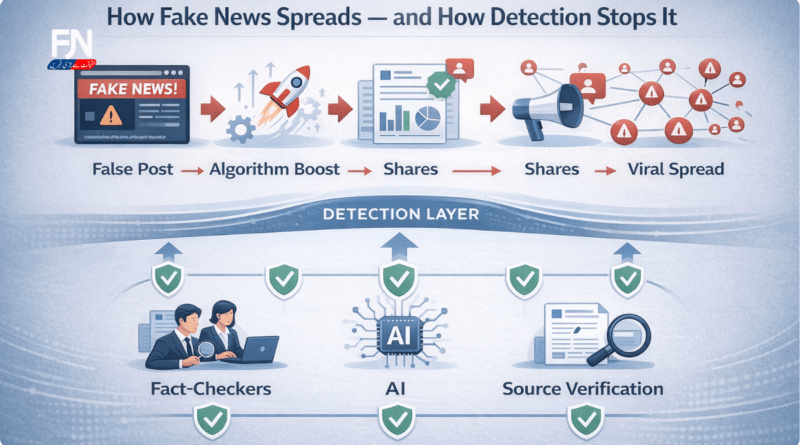
Distribution patterns (how and where content spreads)
Modern detection combines journalistic verification with computational techniques such as machine learning, network analysis, and metadata inspection.
Why Fake News Detection Matters
The consequences of unchecked misinformation are real and measurable. According to research from Pew Research Center, false or misleading news reduces trust in institutions and increases political polarization.
Fake news detection matters because it:
-
Protects democratic processes
-
Prevents public health misinformation
-
Safeguards journalism’s credibility
-
Reduces social and economic harm
During crises—such as elections, pandemics, or natural disasters—false information can spread faster than verified reporting, making early detection essential.
A Brief History of Fake News Detection
While misinformation has existed for centuries, digital platforms transformed its scale. Early detection efforts relied on manual fact-checking by journalists. As social media accelerated content sharing, automated approaches became necessary.
By the mid-2010s, universities, news organizations, and technology companies began developing algorithmic systems capable of flagging suspicious content in real time. Today, fake news detection is an interdisciplinary field spanning journalism, computer science, psychology, and public policy.
Core Approaches to Fake News Detection
Content-Based Detection
Content-based methods analyze the news item itself.
Textual Analysis
Algorithms and journalists look for:
-
Sensational or emotionally loaded language
-
Excessive use of adjectives and pronouns
-
Clickbait-style headlines
-
Logical inconsistencies or unsupported claims
Natural Language Processing (NLP) allows machines to detect patterns humans might overlook at scale.
Visual Analysis
Images and videos are examined for:
-
Manipulation or AI generation
-
Metadata inconsistencies (date, location, device)
-
Image–text mismatches
Social Context-Based Detection
Fake news often reveals itself through how it spreads.
Network Analysis
This approach studies:
-
Speed of dissemination
-
Bot-like sharing behavior
-
Coordinated amplification networks
Sudden spikes in engagement from newly created accounts are a common red flag.
User-Based Analysis
Detection systems assess:
-
Account age and posting history
-
Follower-to-following ratios
-
Repetitive sharing patterns
This helps identify inauthentic actors driving misinformation campaigns.
Hybrid Detection Systems
The most accurate fake news detection systems combine:
-
Text analysis
-
Image and video verification
-
Social network data
Hybrid models consistently outperform single-method approaches, especially in fast-moving online environments.
The Role of Artificial Intelligence in Fake News Detection
Manual fact-checking alone cannot keep pace with today’s information volume. AI has become essential.
Machine Learning (ML)
Traditional ML models—such as Support Vector Machines and Random Forests—classify content using labeled datasets from fact-checking organizations.
Deep Learning (DL)
Advanced systems use:
-
Neural networks
-
Transformer-based language models
-
Context-aware semantic analysis
While AI dramatically improves speed and scale, experts caution that it must support—not replace—human editorial judgment.
Real-World Examples of Fake News Detection
-
News agencies like Reuters use verification desks to authenticate viral images and videos before publication.
-
During global health emergencies, false medical claims are flagged using a mix of AI tools and expert review, often referencing guidance from organizations like World Health Organization.
-
Election coverage increasingly relies on automated systems to detect coordinated disinformation campaigns in real time.
How Individuals Can Help Detect Fake News
Fake news detection isn’t limited to professionals. Everyday readers play a vital role.
Practical Steps You Can Take
-
Check the source – Is it a known, reputable outlet?
-
Evaluate the author – Are credentials and background transparent?
-
Confirm the date – Old stories are often recycled in new contexts.
-
Watch emotional language – Outrage-driven content deserves scrutiny.
-
Verify with fact-checkers – Cross-check claims with established organizations.
These habits significantly reduce the likelihood of spreading false information.
Common Myths About Fake News Detection
Myth: Fake news detection is censorship.
Fact: Detection identifies falsehoods; editorial decisions remain transparent and evidence-based.
Myth: AI can perfectly identify fake news.
Fact: AI improves efficiency but still struggles with satire, nuance, and context.
Myth: Only political news is affected.
Fact: Fake news spans health, science, finance, and entertainment.
Expert Insight: Why Human Judgment Still Matters
Editors and media researchers emphasize that detection tools are aids, not arbiters. According to editorial standards referenced by BBC, verification requires context, ethics, and accountability—qualities algorithms alone cannot provide.
The most effective systems blend technology with professional skepticism and transparency.
Actionable Takeaways
-
Fake news detection is a shared responsibility
-
AI enhances, but does not replace, human verification
-
Media literacy remains the strongest long-term defense
-
Pausing before sharing is a powerful intervention
Frequently Asked Questions (FAQ)
What is fake news detection?
It is the process of identifying intentionally false or misleading news using human verification, AI, or both.
Can fake news detection tools be trusted?
When used with credible sources and human oversight, they are highly effective.
Is fake news detection only for journalists?
No. Many tools and techniques are accessible to the general public.
How is fake news different from misinformation?
Fake news is deliberately deceptive, while misinformation may spread unintentionally.
Conclusion
Fake news detection has become one of the defining challenges of the digital age. As information moves faster and deception grows more sophisticated, the ability to verify truth is no longer optional—it is essential.
By combining advanced technology, professional journalism, and informed audiences, fake news detection helps protect public trust and democratic discourse. Readers who understand how detection works are better equipped to navigate today’s complex media environment.
To deepen your understanding, explore Fact Nama’s guides on media literacy and critical thinking and fact checking tools—skills every modern reader should master.
Suggested Internal Links (Fact Nama)
Sources
-
Reuters Verification Handbook
-
BBC Editorial Guidelines
-
World Health Organization (WHO)
Fact Nama — Evidence-based journalism in the age of misinformation.
